
Protocol IRR
Q3 2027Less water per irrigated hectare.
The water the crop consumes less, locked against the rebound effect, becomes an asset you can put to work.The water the crop consumes less, locked against the rebound effect, becomes an asset you can put to work.
02The situation
Saving water on the field is not enough.
Agriculture draws most of the world's fresh water and consumes half of Europe's. More efficient irrigation can save a great deal, provided the water saved is not used again elsewhere.Agriculture consumes half of the water used in the EU.
03Who it is for
What each party gains.
One saving, certified once, serves every party: project developers, irrigation providers, farms and cooperatives, and the companies committed in the basin.One saving, certified once, serves every party.
- Project developersProve the water the basin really gains, to value and finance the modernisation.
- Irrigation and agritech providersDrip, sensors, scheduling: get paid per cubic metre saved and verified.
- Farms and cooperativesFinance your equipment, hold up better in dry years, and prove it.
- Contributing companiesA traceable contribution in your sourcing basin, reusable in your water reporting.
04Methodological alignment
Credible by design.
Built on the references auditors, regulators and funders already use. Nothing that matters is self-declared.
- Water accounting
- VWBA 2.0
- ISO 14046
- Measurement & verification
- IPMVP
- ISO 14064-2
- ISO 14064-3
- Evidence & traceability
- ISO 22095
- ISO/IEC 15459
- Independent verification
- ISO/IEC 17029
- ISO 14065
Data reusable in:CSRD · ESRS E3 · CDP Water Security · SBTN Freshwater · AWS Standard v3.0 · GRI 303 · CEO Water Mandate
05What we certify
The water the basin really gains.
We certify the drop in what the crop consumes, not the drop in water applied. Energy and water quality are associated indicators.The drop in consumption, not in water applied.
- Reduced consumption (WRC). The water the crop consumes less, across the whole farm.
- Pumping energy. The energy no longer used to pump, an associated indicator.
- Water quality. Less fertiliser washed out, shown when the measurement allows.

06How it works
From field to certificate.
Each step leaves evidence the independent verifier can check.Each step leaves verifiable evidence.
 01QualifyBasin under strain, the whole farm in scope, withdrawals metered.
 02Set the baselineSeveral seasons, corrected for climate and crops.
 03Measure real consumptionMeters and satellite across the whole farm, season after season.
 04Lock the savingNo extra irrigated area; the water saved is not consumed again.
 05Verify and certifyAI agents on every data point, validation by an accredited verifier, issuance on the registry.
07The measurement
Only the water consumed less counts.
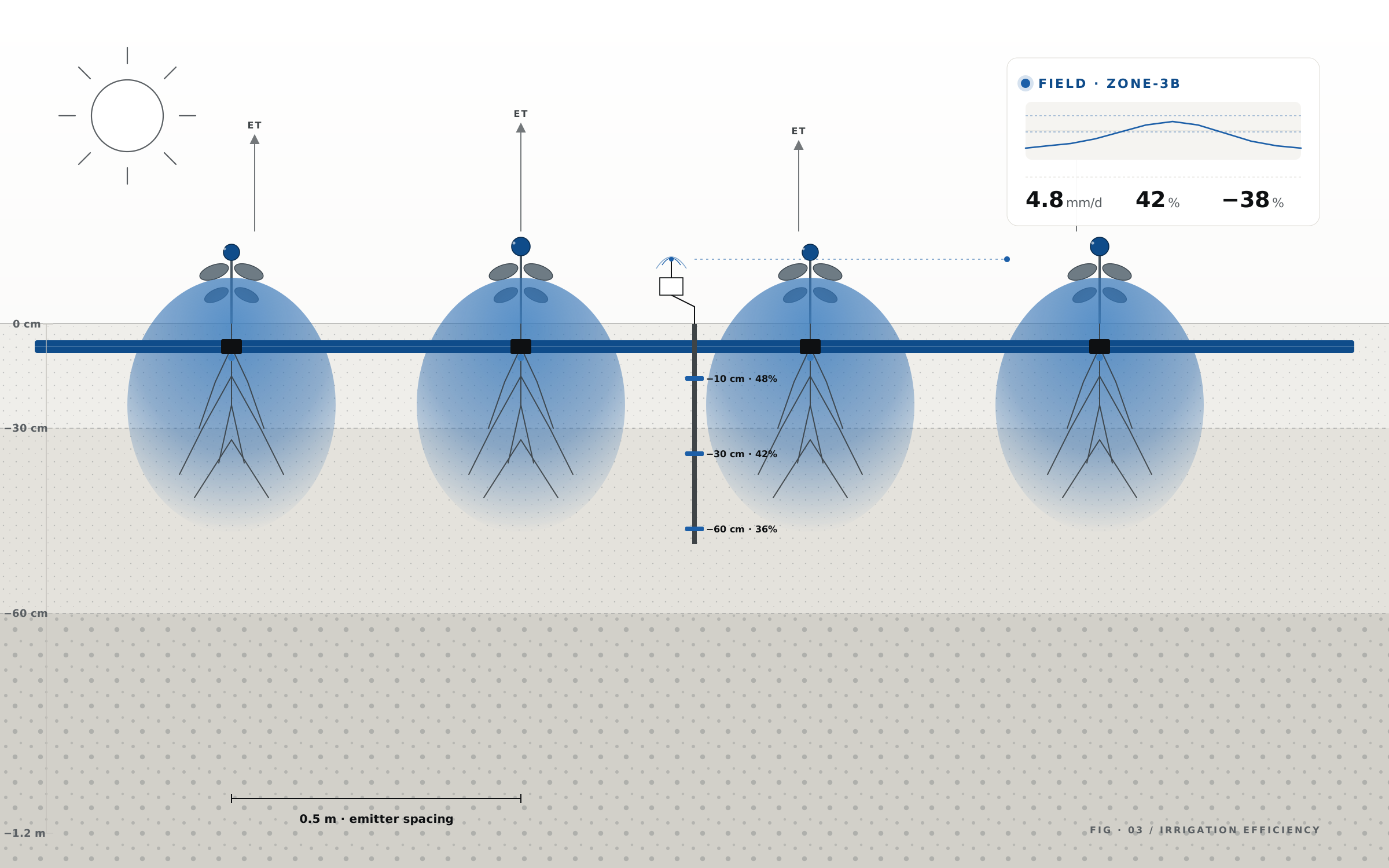
More efficient irrigation applies less water, but part of the water applied already returned to the aquifer. The certified volume is the drop in what the crop consumes, across the whole farm. The detailed calculation and verification method is being developed with the protocol.Only the drop in what the crop consumes counts.
- Less water applied is not enough: consumption is what counts.
- The whole farm, season after season.
- Detailed method being developed with the protocol.

08Funders
Pay for the water saved, not the equipment.
Water agencies, local authorities, funds and companies can pay farmers per cubic metre left in the aquifer, measured and verified by our infrastructure.Pay per verified cubic metre left in the aquifer.
- Payment for ecosystem services. The local authority or water agency pays for the water left in the aquifer, per verified cubic metre rather than per hectare.Per cubic metre, not per hectare.
- Monetising water savings. A city or utility pays a conservation fee indexed on the verified volumes.A fee indexed on the volumes.
- Performance-based loans and grants. The rate or the aid improves as the verified saving grows.The rate follows the saving.
- Company contributions. Companies committed in the basin fund traceable volumes for their water targets, without double counting.Traceable volumes, no double counting.

09Get started
Irrigating in a basin under strain? Make your action count with us.
Start with one site, prove it, then scale up.Start with one farm: prove it, then scale.
+Questions
Does a lower yield count as a saving?
No. Water saved by producing less is not certified as an efficiency gain.
Why not count the water applied less?
Because part of the water applied returns to the aquifer or the river. Only the water the crop consumes less is a gain for the basin.
What is the rebound effect?
When the water saved irrigates more land or thirstier crops, the basin's consumption does not fall. The protocol rules this case out.
Who can fund the savings?
Public bodies, water utilities and the companies committed in the basin can pay per verified cubic metre.
When will the protocol be active?
The target date for this protocol is Q3 2027. We are looking for project developers and irrigation providers to design the protocol methodology on a founding pilot.