
Protocol WRC-NRW
Public consultationCertify the performance of your leak-reduction campaigns.
Operational, environmental and climate performance: every campaign run by network sectorisation is measured, verified by an independent third party and turned into certified cubic metres.Every leak-reduction campaign, measured, independently verified and turned into certified cubic metres.
02The situation
Every year, the world loses a river.
Cutting these losses by a third would meet the needs of 800 million people. Most of it is physical leakage: the resource that digitalisation, detection and repair can recover.Most of these losses are physical leaks: water that can be recovered.
03Who it is for
What each party gains.
One campaign, certified once, serves every party: network operators, solution providers, local authorities and the companies committed in the basin.One campaign, certified once, serves every party.
- Network operatorsFund loss reduction and meet your efficiency targets, with verified proof of performance.
- Solution providersDetection, repair, digitalisation: get paid per cubic metre recovered. Better instrumentation means more certified volume.
- Local authoritiesMake the performance of your public service concession measurable, strengthen its oversight and claim the volumes preserved, recorded on the registry.
- Contributing companiesA traceable contribution in your basin, reusable in your water reporting.
04Methodological alignment
Credible by design.
Built on the references auditors, regulators and funders already use. Nothing that matters is self-declared.
- Water losses
- IWA water balance
- ILI
- ISO 24512
- Water accounting
- VWBA 2.0
- ISO 14046
- Measurement & verification
- IPMVP
- ISO 14064-2
- ISO 14064-3
- Independent verification
- ISO/IEC 17029
- ISO 14065
Data reusable in:CSRD · ESRS E3 · CDP Water Security · SBTN Freshwater · AWS Standard v3.0 · GRI 303 · CEO Water Mandate
05What we certify
A leak-reduction campaign, certified on three performances.
We certify leak-reduction campaigns run by network sectorisation: the network is divided into metered districts, leakage is measured before and after repair, and every result is verified by an independent body.Measured before and after repair, district by district, and verified independently.
- Operational. Real losses recovered in cubic metres, network efficiency and Infrastructure Leakage Index (ILI).
- Environmental. Each cubic metre recovered becomes a Water Resilience Certificate (WRC), traceable to its basin.
- Climate. Pumping and treatment energy avoided, and the related emissions, shown with the certificate.

06How it works
From sectorisation to certificate.
The measurement plan is validated by the independent verifier before works, not after.The verifier validates the measurement plan before works.
 01SectoriseThe network is divided into metered districts: each becomes a measurable unit.
 02Measure beforeMinimum night flow sets each district's baseline before intervention.
 03Detect and repairLeak detection and repairs, with evidence: work orders, location, checks.
 04Measure afterFlow after repair, normalised for pressure and demand, gives the volume recovered.
 05Verify and certifyAI agents on every data point, validation by an accredited verifier, issuance on the registry.
07The measurement
Measuring what is recovered.
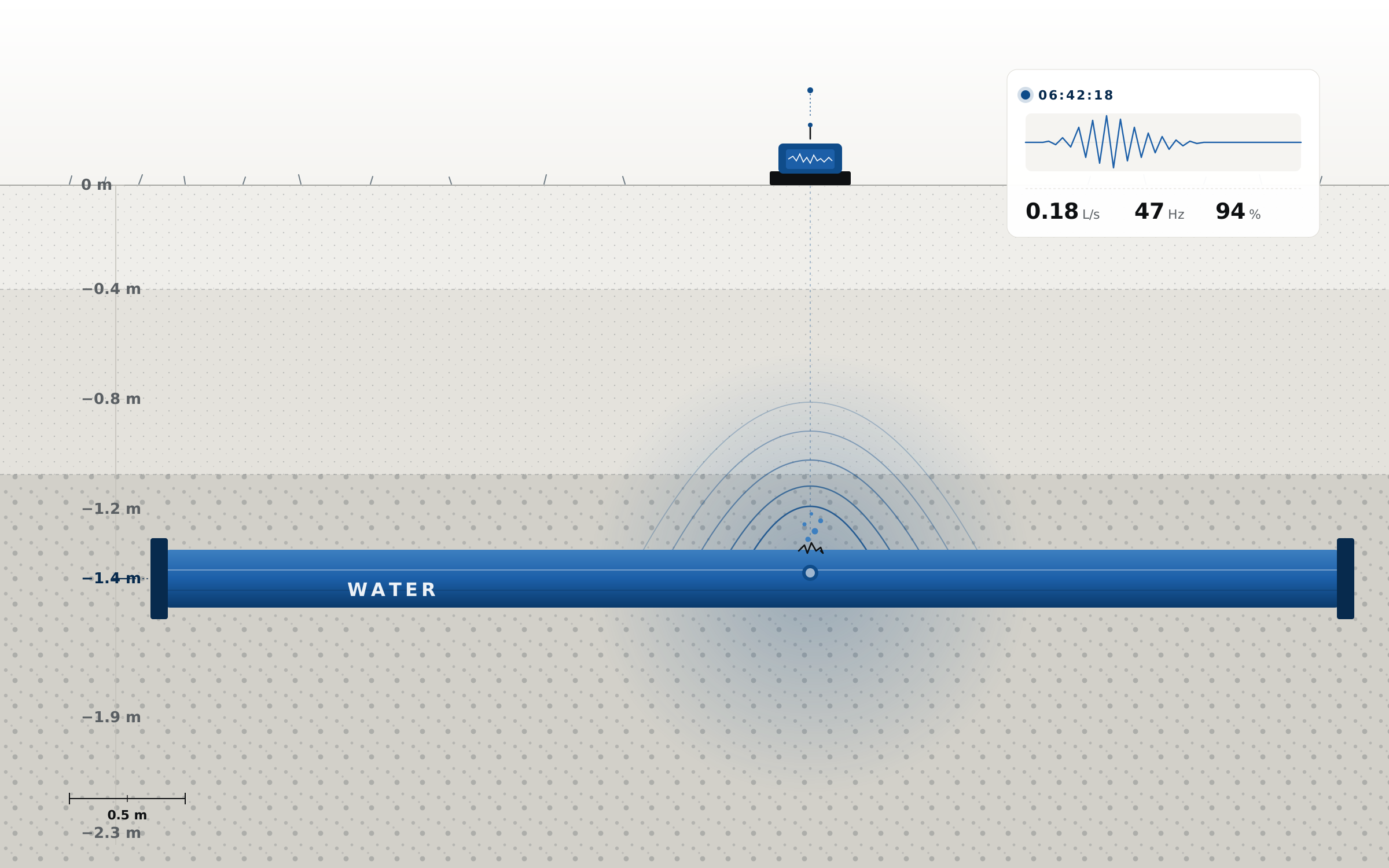
At night, demand is at its lowest: the flow left in a district is mostly leakage. It is measured before and after repair, normalised for pressure and demand. The gap between the two is the volume recovered.Night flow before and after repair: the gap is the volume recovered.
- Minimum night flow measured in each district, before and after.
- Normalised for pressure and demand.
- District meters, pressure sensors and remote reading supply the data.

08Get started
Every cubic metre saved deserves to be financed.
Network operators, local authorities and solution providers: start with one district, measure, certify.Start with one district: measure, certify.
+Questions
Does detection alone qualify?
No. A certificate needs detection, repair and a verified measurement after repair.
Does it cover apparent losses (meter errors, theft)?
No. The protocol counts real losses avoided.
Who can submit a project?
Utilities and leak detection or repair providers running a programme on a drinking water network. The protocol is about to be validated: projects can be submitted for qualification now.
How is the saved volume paid for?
Three ways: payment per cubic metre between provider and utility, Water Resilience Certificates for verified volumes, or corporate co-funding in the basin.
Who verifies the measurement?
An independent, accredited body checks the evidence and signs. Veracity never verifies.
Is the certificate an offset?
No. A WRC documents a contribution in the project’s basin, not an offset: water cannot be exchanged from one basin to another.